


Terre de l’Élu Roc’h Avel 2025
An organic Loire white blending old-vine Chenin Blanc and Sauvignon Blanc, with ripe pear, fennel, fresh almond and a long saline finish.
Wine Details
Tasting Notes


How This Wine Feels In The Glass
What This Wine Loves With

Seafood

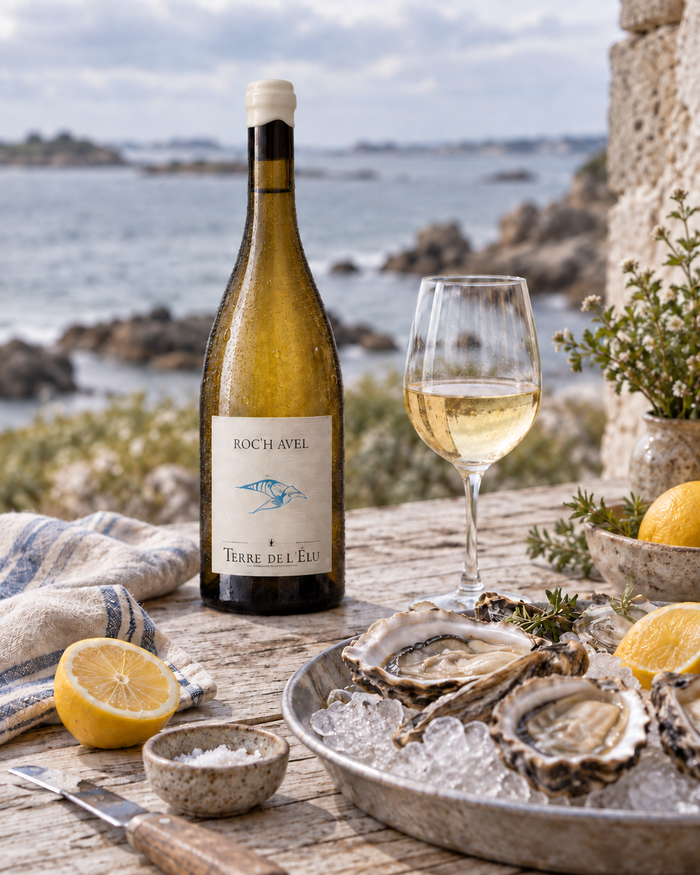
Oysters

White Meat

Cheese
What We Drink This With.
Pairs beautifully with
Add pairing images and labels in the block settings to display food pairings.
Why we chose this wine
Certified Organic • Biodynamic • Hand Harvested • Indigenous Yeasts • Low Intervention
A Loire white with breadth, freshness and a coastal soul
Terre de l’Élu Roc’h Avel 2025 is a dry, organic white from Anjou Noir in the Loire Valley. It brings together 80% Chenin Blanc and 20% Sauvignon Blanc: Chenin supplies texture, orchard fruit and quiet power, while Sauvignon adds lift, fragrance and a bright line of freshness.
The result is generous without feeling heavy. Ripe pear, grapefruit and fresh almond unfold around more savoury notes of liquorice and fennel, before a long saline finish carries a delicate touch of anise. It is a characterful Loire white to enjoy slowly, and an exceptionally versatile bottle at the table.
What is Roc’h Avel?
“Roc’h Avel” means “the rock of the wind” in Breton. The name nods to Charlotte and Thomas Carsin’s Breton roots and to the maritime imagery that runs through Terre de l’Élu. It also suits the wine itself: mineral, energetic and touched by a distinctly briny freshness.
Roc’h Avel is produced from two old-vine parcels, L’Aiglerie and Les Barres, in the dark-soiled landscape known as Anjou Noir. This western part of Anjou sits on the ancient Armorican Massif, where schist and other volcanic and sedimentary rocks create wines with depth, tension and a savoury mineral character.
Why is it labelled Vin de France?
Roc’h Avel is officially classified as Vin de France rather than under an AOC or AOP. Terre de l’Élu chose to step outside the Anjou appellation framework in 2019, giving Charlotte and Thomas the freedom to express their sites and blends on their own terms.
Vin de France here is therefore a designation, not a shortcut. The wine comes from carefully farmed Loire vineyards and is made with the same exacting attention as an appellation wine. For the product title, “Terre de l’Élu Roc’h Avel 2025” is the clearest and most accurate wording; no AOC or DOCG suffix should be added.
Discover the blend
Chenin Blanc forms 80% of the blend. It is one of the Loire’s great white grapes, loved for its natural acidity, layered orchard fruit and ability to carry both richness and mineral detail. In Roc’h Avel, it gives the wine its ripe pear, almond and gently rounded mid-palate.
The remaining 20% is Sauvignon Blanc. Rather than dominating the wine with overtly tropical aromas, it sharpens the edges with citrus, herbs and freshness. Together, the two varieties feel complete: textured yet precise, expressive yet composed.
The vineyard
The fruit comes from the lieux-dits L’Aiglerie and Les Barres. The vines are between 40 and 70 years old, with roots established deep in sandstone schist, quartz and cinerite. These lean, free-draining soils naturally limit vigour and encourage small yields with concentrated flavour.
The schist landscape is central to Terre de l’Élu’s identity. Dark stones warm quickly and the fractured subsoil allows vine roots to travel through fissures in search of water and nutrients. In the finished wine, that origin is expressed less as a simple “stone” flavour and more as tension, salinity and a persistent savoury finish.
The Terre de l’Élu story
Charlotte and Thomas Carsin took over the estate in Saint-Aubin-de-Luigné in 2008. Thomas brought experience as a viticulture consultant, while Charlotte developed the domaine alongside him through its communications, commercial life and creative direction. Food, hospitality and the pleasure of sharing wine have always been at the centre of their work.
Across more than 20 hectares, the couple grows a broad range of Loire varieties and makes wines that are led by place rather than by formula. Their approach is thoughtful and curious, combining close observation in the vineyard with low-intervention work in the cellar.
Organic farming and a living landscape
The entire estate was converted to organic farming and has been certified by Ecocert since 2013. The vines are worked with a focus on soil life, resilience and biodiversity. Spontaneous cover crops and green manures help protect and feed the soils, while herbal infusions and plant extracts support the vines through the growing season.
Terre de l’Élu has also planted hedgerows and fruit trees and welcomes sheep into the vineyards during winter. These choices make the parcels feel less like isolated monocultures and more like living agricultural landscapes. Yields remain naturally modest, and the grapes are harvested entirely by hand.
How is Roc’h Avel made?
The grapes are picked by hand into small 20-kilogram crates to protect the fruit on its journey to the cellar. Whole bunches are pressed directly and the juice ferments with indigenous yeasts—the naturally occurring yeasts carried from vineyard to winery—rather than with a standardised commercial culture.
The wine is raised for six months in tank. Partial malolactic fermentation softens the texture and gives a tender, rounded feel while preserving the line of freshness that makes the wine so drinkable. The élevage is deliberately restrained: there is no oak flavour to cover the fruit, herbs or mineral detail.
What does it taste like?
The first impression is aromatic and savoury, with liquorice and fresh fennel leading into grapefruit and ripe pear. With air, the wine becomes more generous, showing yellow fruit, fresh almond and a subtle floral note.
On the palate, it has real volume but remains lively and precise. The texture is smooth rather than creamy, held in shape by fresh acidity. The finish is long, saline and lightly aniseed, leaving the mouth refreshed and ready for another sip.
Is Roc’h Avel sweet?
No. Roc’h Avel is a dry white wine. Its ripe fruit and rounded texture can give a sense of generosity, but the finish is savoury, fresh and clean rather than sweet.
Should I decant it?
Decanting is not essential, though the wine benefits from a little air. Open it 10 to 15 minutes before serving, or pour a first glass and allow the bottle to develop naturally. Serve at around 12°C—cool, but not icy—so that the pear, fennel and almond notes can fully emerge.
Roc’h Avel is delicious now and can also be cellared for up to five years. With time, expect the fresh fruit to move toward softer orchard, honeyed and nutty tones while the wine’s saline backbone remains.
What should I drink it with?
This is a natural seafood wine. Try it with oysters, prawns, scallops, crab, grilled fish or stuffed squid. Its saline edge mirrors shellfish beautifully, while its texture is generous enough for richer sauces and roasted vegetables.
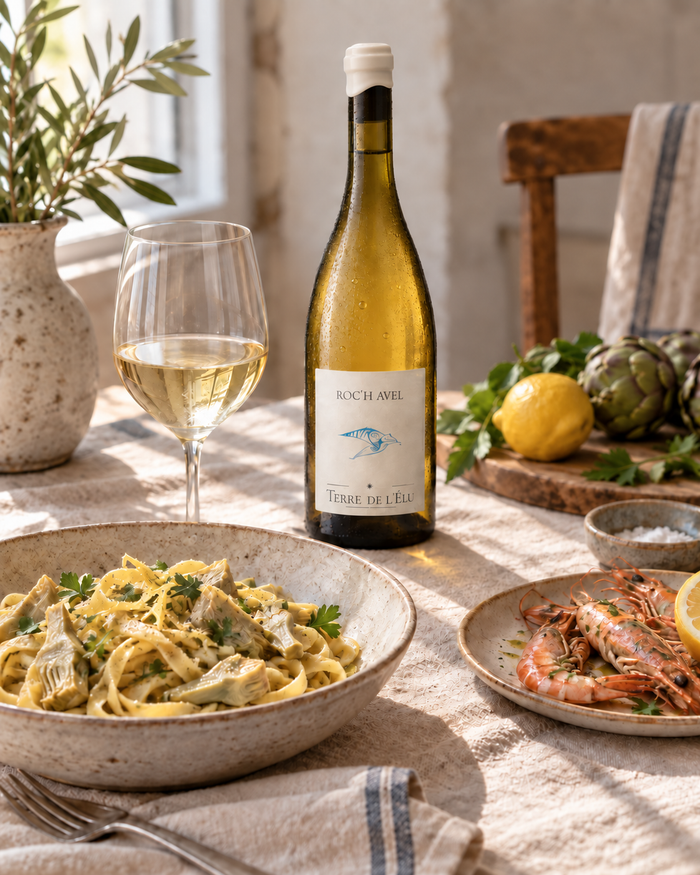
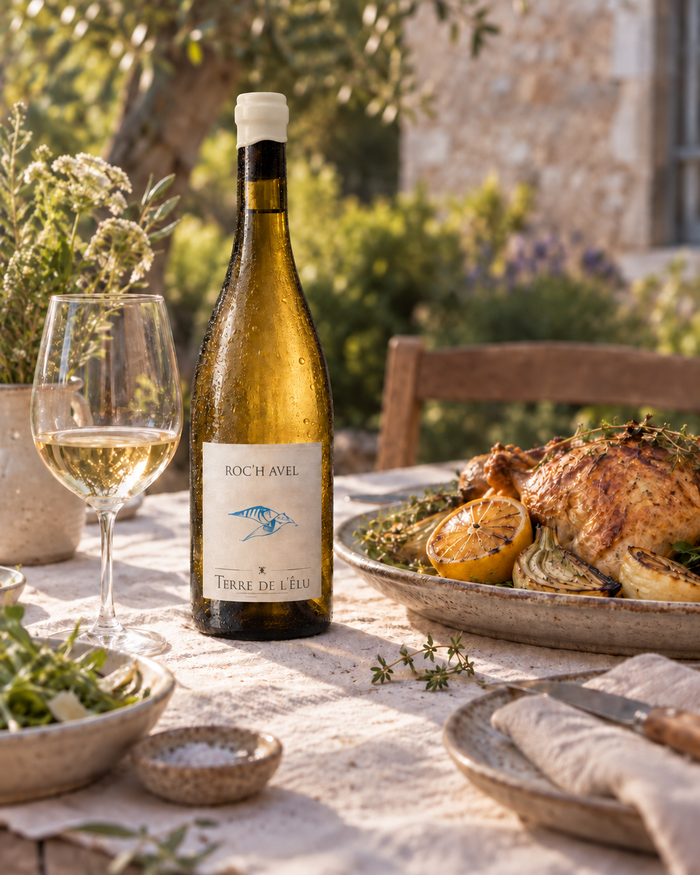
It is also excellent with fresh goat’s cheese dressed with olive oil and garden herbs, lemon-and-herb pasta, artichoke dishes, roast chicken with fennel, or a simple plate of pears and young chèvre. The combination of freshness and breadth makes it especially useful when a meal moves between vegetables, cheese and seafood.
White Wine
Terre de l’Élu Roc’h Avel 2025
An organic Loire white blending old-vine Chenin Blanc and Sauvignon Blanc, with ripe pear, fennel, fresh almond and a long saline finish.
Australia Post: Sydney usually next business day. Queensland and Victoria around 2 business days after dispatch. Check your postcode.

At a glance
TasteCitrus, fresh herbs and a lively, clean finish.
Best withSeafood, white meat and fresh cheese.
ServeServe chilled, then let it warm gently in the glass so its fruit and texture can open.
FromAnjou Noir, Loire Valley, France
Bottle facts
The useful details.
- Vintage
- 2025
- Style
- Dry White Wine
- Grape
- 80% Chenin Blanc, 20% Sauvignon Blanc
- Origin
- Anjou Noir, Loire Valley, France
- Farming
- Organic · Biodynamic
- Appellation
- Vin de France
- Closure
- Natural cork
- Bottle
- 750ml
Wine passport
The style in seconds.
A quick visual guide for new drinkers, with the useful detail wine lovers expect.
Tasting notes
What you will notice.
Mineral
Clean, stony freshness in the glass.
Nutty
Delicate savoury, nut-like complexity.
Fennel
A fresh, gently herbal aromatic note.
An easy way to choose
What to eat. When to open it.
Best food pairings
 Seafood
 Oysters
 White meat
The wine and its maker
The story in the bottle.
Certified Organic • Biodynamic • Hand Harvested • Indigenous Yeasts • Low Intervention
A Loire white with breadth, freshness and a coastal soul
Terre de l’Élu Roc’h Avel 2025 is a dry, organic white from Anjou Noir in the Loire Valley. It brings together 80% Chenin Blanc and 20% Sauvignon Blanc: Chenin supplies texture, orchard fruit and quiet power, while Sauvignon adds lift, fragrance and a bright line of freshness.
The result is generous without feeling heavy. Ripe pear, grapefruit and fresh almond unfold around more savoury notes of liquorice and fennel, before a long saline finish carries a delicate touch of anise. It is a characterful Loire white to enjoy slowly, and an exceptionally versatile bottle at the table.
What is Roc’h Avel?
“Roc’h Avel” means “the rock of the wind” in Breton. The name nods to Charlotte and Thomas Carsin’s Breton roots and to the maritime imagery that runs through Terre de l’Élu. It also suits the wine itself: mineral, energetic and touched by a distinctly briny freshness.
Roc’h Avel is produced from two old-vine parcels, L’Aiglerie and Les Barres, in the dark-soiled landscape known as Anjou Noir. This western part of Anjou sits on the ancient Armorican Massif, where schist and other volcanic and sedimentary rocks create wines with depth, tension and a savoury mineral character.
Why is it labelled Vin de France?
Roc’h Avel is officially classified as Vin de France rather than under an AOC or AOP. Terre de l’Élu chose to step outside the Anjou appellation framework in 2019, giving Charlotte and Thomas the freedom to express their sites and blends on their own terms.
Vin de France here is therefore a designation, not a shortcut. The wine comes from carefully farmed Loire vineyards and is made with the same exacting attention as an appellation wine. For the product title, “Terre de l’Élu Roc’h Avel 2025” is the clearest and most accurate wording; no AOC or DOCG suffix should be added.
Discover the blend
Chenin Blanc forms 80% of the blend. It is one of the Loire’s great white grapes, loved for its natural acidity, layered orchard fruit and ability to carry both richness and mineral detail. In Roc’h Avel, it gives the wine its ripe pear, almond and gently rounded mid-palate.
The remaining 20% is Sauvignon Blanc. Rather than dominating the wine with overtly tropical aromas, it sharpens the edges with citrus, herbs and freshness. Together, the two varieties feel complete: textured yet precise, expressive yet composed.
The vineyard
The fruit comes from the lieux-dits L’Aiglerie and Les Barres. The vines are between 40 and 70 years old, with roots established deep in sandstone schist, quartz and cinerite. These lean, free-draining soils naturally limit vigour and encourage small yields with concentrated flavour.
The schist landscape is central to Terre de l’Élu’s identity. Dark stones warm quickly and the fractured subsoil allows vine roots to travel through fissures in search of water and nutrients. In the finished wine, that origin is expressed less as a simple “stone” flavour and more as tension, salinity and a persistent savoury finish.
The Terre de l’Élu story
Charlotte and Thomas Carsin took over the estate in Saint-Aubin-de-Luigné in 2008. Thomas brought experience as a viticulture consultant, while Charlotte developed the domaine alongside him through its communications, commercial life and creative direction. Food, hospitality and the pleasure of sharing wine have always been at the centre of their work.
Across more than 20 hectares, the couple grows a broad range of Loire varieties and makes wines that are led by place rather than by formula. Their approach is thoughtful and curious, combining close observation in the vineyard with low-intervention work in the cellar.
Organic farming and a living landscape
The entire estate was converted to organic farming and has been certified by Ecocert since 2013. The vines are worked with a focus on soil life, resilience and biodiversity. Spontaneous cover crops and green manures help protect and feed the soils, while herbal infusions and plant extracts support the vines through the growing season.
Terre de l’Élu has also planted hedgerows and fruit trees and welcomes sheep into the vineyards during winter. These choices make the parcels feel less like isolated monocultures and more like living agricultural landscapes. Yields remain naturally modest, and the grapes are harvested entirely by hand.
How is Roc’h Avel made?
The grapes are picked by hand into small 20-kilogram crates to protect the fruit on its journey to the cellar. Whole bunches are pressed directly and the juice ferments with indigenous yeasts—the naturally occurring yeasts carried from vineyard to winery—rather than with a standardised commercial culture.
The wine is raised for six months in tank. Partial malolactic fermentation softens the texture and gives a tender, rounded feel while preserving the line of freshness that makes the wine so drinkable. The élevage is deliberately restrained: there is no oak flavour to cover the fruit, herbs or mineral detail.
What does it taste like?
The first impression is aromatic and savoury, with liquorice and fresh fennel leading into grapefruit and ripe pear. With air, the wine becomes more generous, showing yellow fruit, fresh almond and a subtle floral note.
On the palate, it has real volume but remains lively and precise. The texture is smooth rather than creamy, held in shape by fresh acidity. The finish is long, saline and lightly aniseed, leaving the mouth refreshed and ready for another sip.
Is Roc’h Avel sweet?
No. Roc’h Avel is a dry white wine. Its ripe fruit and rounded texture can give a sense of generosity, but the finish is savoury, fresh and clean rather than sweet.
Should I decant it?
Decanting is not essential, though the wine benefits from a little air. Open it 10 to 15 minutes before serving, or pour a first glass and allow the bottle to develop naturally. Serve at around 12°C—cool, but not icy—so that the pear, fennel and almond notes can fully emerge.
Roc’h Avel is delicious now and can also be cellared for up to five years. With time, expect the fresh fruit to move toward softer orchard, honeyed and nutty tones while the wine’s saline backbone remains.
What should I drink it with?
This is a natural seafood wine. Try it with oysters, prawns, scallops, crab, grilled fish or stuffed squid. Its saline edge mirrors shellfish beautifully, while its texture is generous enough for richer sauces and roasted vegetables.
It is also excellent with fresh goat’s cheese dressed with olive oil and garden herbs, lemon-and-herb pasta, artichoke dishes, roast chicken with fennel, or a simple plate of pears and young chèvre. The combination of freshness and breadth makes it especially useful when a meal moves between vegetables, cheese and seafood.
How to enjoy it
Chill, pour and let it open.
Serve chilled, then let it warm gently in the glass so its fruit and texture can open.

Customer reviews